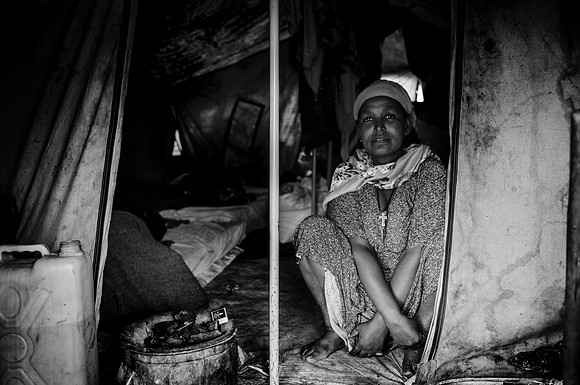
"We used to be the ones who people came to for help..", Benishangul-Gumuz
Ageritu Beleta has been move to the current location from another IDP site, due to declining security in the previous site. She is here with her family of eight, sharing a small tent the size of an estimated 3 x 3 square metres. They have been displaced now for a total of 4 years, including the previous IDP site she was residing.
They were forewarned before the militia raided their village, for no apparent reason other than that politically-driven, destroying agricultural land, homes, murdering people. They hid in a hole underground and were protected for one night until they were moved to their first IDP location. It was not possible for them to return to their village as their homes were damaged in the conflict. In addition, their land, home and belongings were all repossessed by neighbouring ethnic groups not long after. There is constant security concerns in that area as there is no saying when the militia group will strike again, hence an almost impossible dream of returning to where they’ve come from, at least in the medium term.
They have been promised rations of wheat by the government, their only source of food - 15kg of wheat per person in the family. This is a sufficient amount of a month. They laughed as I asked how many meals they have a day. Currently it is enough for a single meal a day if that as some of the wheat is sold to enable them to purchase other NFI (non-food items) that are not provided by aid agencies or the government. Nothing else is provided with the wheat. No cooking utensils, spices or the like, which is obtained via the sale of some of their rations. The last rations were provided 3 months ago, supposedly due to wheat supply issues relating to the Ukrainian/Russian war. The only NFIs provided are a blanket per person and a jerrycan for the family. Current tents are leaking and holes mended using leftover tents from the previous displaced group.
Whilst water can be obtained from a groundwater pump, the rest of the facilities in the site barely meet sound sanitation requirements. Basic health care is available once every morning, providing general medicine for the likes of malaria or illness stemming from a lack of basic sanitation facilities. They share a single lavatory that is exposed to the elements as all the plastic sheeting around it is debilitated. They have been relocated to a small town where prospects of selling basic things for a minimal amount of money is scarce. Their initial feeling of anxiety around being attacked and displaced has now been replaced with a more dire need to survive.
The children are able to attend a local school. However due to not having an income and an ability to cover the cost of school materials, the children are not able to go to school.
These are people who were self sufficient, with their own farming land and crops. They had their own iron sheet houses. They were the ones people came to for help. They were the ones supporting those in need. Now they’ve lost it all - their homes, their harvest, their lives.
They have lost hope about going back to where they’ve come from. The government promised to assist with recovery costs, ie costs of recovering their homes and lands however that is yet to come to fruition.